
Usyk and Fury agree again: the trilogy is no longer a joke
09.09.2026When a champion posts a training video and their opponent immediately responds with a "last dance" poster, the ring becomes the main stage of heavyweight wrestling once again.
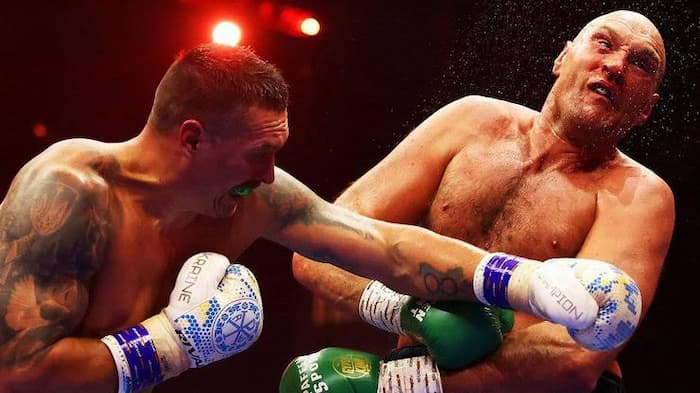
Oleksandr Usyk and Tyson Fury have once again made the boxing world freeze. Not with a contract or a press conference — with a short, almost everyday exchange on social media, which suddenly took on the weight of an official statement. The Ukrainian showed footage from the hall and directly addressed the Briton. The Briton did not remain silent: first a sarcastic comment, then a full-fledged poster of a possible third fight with the inscription that the trilogy is "already in the works." Usyk picked up the story and posted it on his stories. They have already shared the ring twice in 2024 — and twice the judges' cards sided with the Ukrainian. Now it's time for the third act again. And this time the tone sounds not like a polite hypothesis, but like a statement that is difficult to dismiss. 1
What exactly did Usyk and Fury say to each other?
Usyk posted a training video on Instagram. No long speeches, no press releases. On camera — work, rhythm, the familiar calm of a man who is used to talking business. The address was direct: “Hey, Tyson, I’m following you, my brother. You are Greedy Belly.” The formula is both familiar and provocative: “brother” next to a nickname that has already become part of their public dialogue. This is how Usyk often mixes warmth and sting — and this is how the ring perceives his messages most acutely.
Fury's response was not long in coming. The Briton left a comment under the video: "A real man! Usyk is not a duck, but still a rabbit." This is the classic style of "The Gypsy King" - a play on words, jokes, theatricality, in which there is always a grain of serious challenge. Then he went further than the text: he released a poster of a possible third fight. It contains wording that immediately makes the temperature in the heavyweight hall soar: "The trilogy is already in the works. The land of real men, it's time to take it back. The last dance of the warriors of the modern world. Coming soon." Usyk did not disavow himself. He reposted the poster in his stories - a gesture that is clearly read in boxing: the dialogue is accepted, the topic is alive. 1
To an outsider, this may seem like just network noise. For those who follow the heavyweight division, the picture is different. When two absolute headliners talk synchronously about a third fight and back up their words with the visual image of the poster, the market begins to consider not emotions, but calendar windows, television rights, and promoter politics.
Two battles from 2024 that made the trilogy logical
The first and second fights between Usyk and Fury in 2024 are already inscribed in the recent history of the division. Both times the Ukrainian won by decision. This is important not only for his personal record. It is the “decision, not an early knockout” format that leaves the argument for a rematch in the air: in the British camp you can always say about the close nature of the confrontation, about the cards, about the nuances of the rounds. In Usyk's camp, there is an opposite emphasis: they came together twice, the advantage was recorded twice, the status was confirmed.
It is this duality that fuels the idea of a trilogy. In boxing, a third fight rarely arises from champion courtesy. It appears where the public has not felt the point, where the box office potential remains huge, and where both camps see a chance to write their own version of history. Usyk, after two wins, looks like the side that can dictate the terms. Fury is the side that needs a big symbolic return to the top after a pause and an uneven period.
Their styles are still read as a perfect dramatic contrast. Usyk - mobility, footwork, distance control, the ability to "steal" rounds with small but clean episodes. Fury - dimensions, improvisation, clinch, psychological pressure and the ability to change the pattern of the fight in the middle of the round. When such profiles meet for the third time, the viewer buys not only the blow, but also the intellectual game: who will first impose his pace, who will withstand the middle of the distance, who will not "break" in the championship minutes.
Fury's return and why Usyk's name is being heard again right now
After losing two fights to Usyk, Fury announced his retirement, but later returned. On April 11, he defeated Arslanbek Makhmudov, a Russian with a Canadian passport, by unanimous decision. In July in Thailand, the Briton defeated the experienced Pole Mariusz Wach: the opponent refused to go to the eighth round. Formally, these are victories. In substance, it is a stage of acceleration, an attempt to regain ring rhythm, a name, and negotiating power. 1
At the same time, his big British storyline against Anthony Joshua has come under question. It is the slippage around this match that creates a vacuum into which the Usyk topic easily falls. When a “home” superfight slips, promoters and the boxer himself are looking for a story with even higher global recognition. Usyk gives such a story automatically: it has happened twice already, the third time is already a “saga”, not just a rematch.
Fury is always a master at manipulating public narrative. The poster about the "land of real men" and the "last dance" is not a random creative move. It is an attempt to fix the third fight as an event of final significance, almost as a ritual of closing an era. For the market, such formulations are convenient: they raise the stakes even before the fee figures appear.
Usyk's plans: Deontay Wilder to say goodbye and make room for Fury
The Ukrainian champion currently has two lines running parallel. The first is a sports classic for a big name: he is planning a farewell fight in the US against Deontay Wilder in the spring of 2027. This is the logic of the "last big night" in the American market, where Wilder's name is still associated with the knockout mythology of heavyweight. The second line is an open European-British plot with Fury, which flared up again after a fresh exchange of statements. 1
Do these plans contradict each other? Not necessarily. The elite boxing calendar can stretch if the interests of television platforms and sponsors coincide. But priorities are strict. Every big fight takes months of preparation, recovery, and promotion. That's why Fury's phrase "a trilogy is already in the works" is interesting precisely because of how quickly it can move from the language of posters to the language of contracts. With his repost, Usyk showed openness to conversation. Openness is not yet a signature. However, in boxing, it is precisely with such gestures that serious bargaining often begins.
For the Ukrainian audience, there is a separate dimension here. Usyk has long gone beyond the sports column: he is a figure of national symbolic rank, a boxer whose victories are read wider than the ring. Therefore, any conversation about a third fight with Fury is not only a question of titles. It is a question of in what tone the loudest international story of Ukrainian boxing in recent years will end or continue.
Why a third fight would be bigger than a regular rematch
A heavyweight trilogy is a rare genre. It requires not only box office, but also mutual openness of the story. After two decisions in favor of Usyk, the third fight automatically acquires several layers of meaning. For the Ukrainian, it is a chance to put an end to three victories and finally transfer the rivalry to the status of complete dominance. For Fury, it is a chance to rewrite the finale, return the "land" that he has already managed to declare on the poster, and prove that the pause and comeback were the path to the main night, and not a catch-up with the past.
There is also business logic. The names of Usyk and Fury guarantee international coverage: the UK, Ukraine, USA, the Middle East as a venue for major events, global streaming windows. After two fights, the pair's recognition has only increased. A third fight sells easier than many "new" crossovers, because the audience already knows the plot and wants a third act with a different ending or with a final confirmation of the previous one.
There is a separate issue of beltvable drama. Fury knows how to enter the hall as a showman. Usyk knows how to enter as a strategist. Together they give a rare mix: a meme, a master class, and the politics of champion ambitions. That is why even a short dialogue on social networks raises waves faster than dry statements from promoters.
What could hinder the trilogy and what would help it?
The very first barrier is the calendar and the already announced priorities. Wilder is a serious anchor in Usyk's plans for the spring of 2027. Fury still has a smoldering relationship with Joshua, even if it is under threat of disruption. The second barrier is money and venue. A third fight of this level rarely fits into the "normal" fee pattern: the parties will bargain for shares, for the venue, for the order of broadcast windows, for bonus incentives.
The third barrier is sporting risk. There's no point in giving away a big night to Usyk without a clear sporting and financial rationale. Fury, on the other hand, needs a big name to make his comeback look not like a series of victories over easy opponents, but like a return to the center of the card. This asymmetry of motives can both accelerate and slow down a deal.
What's playing into their hands? The public momentum has already been created. There are mutual direct appeals. There is a poster. There is a repost. There is a story of two fights. There is a hunger of the audience for a clear status quo in the division, where rematches, interim fights and long negotiations are constantly mixed. In such a climate, the Usyk-Fury trilogy sounds like the purest plot: without unnecessary explanations, with ready-made drama.
Between nicknames and championship calculations
"Greedy belly", "rabbit", "real man", "last dance" - this is the surface. Beneath it lies the cold arithmetic of fame. Usyk once again shows that he controls the pace of the conversation even when he speaks briefly. Fury once again shows that he knows how to make a poster out of one line. Together they have once again started a topic that the market cannot ignore.
Does this mean that a contract is inevitable in the coming weeks? No. It means something else: a third fight is back on the agenda not as a fan's dream, but as a working scenario. In heavyweight, such scenarios most often become reality - after a series of denials, clarifications and a sudden "everything came together."
So far, there are enough facts for a serious conversation. Usyk has publicly stepped into the territory of the challenge. Fury responded with a trilogy poster. The Ukrainian picked up the poster. Behind him are two victories for Usyk in 2024. Fury has a comeback through Makhmudov and Vakh. Ahead of Usyk is the American line with Wilder. Fury has uncertainty with Joshua. At the intersection of these lines, the loudest "what if" in modern boxing flared up again. 1
Ukrainian perspective: why this dialogue is more important than the usual sports noise
For the Ukrainian reader, Usyk's story is always broader than the round table. Each of his big fights becomes a shared emotional event that gathers an audience beyond the purely sporting niche. Therefore, the new round with Fury is perceived not as another infomercial, but as a possible continuation of the main ring saga of the generation.
At the same time, a mature view requires calm. Social media exchanges are not the end of the deal. But it is the ability to distinguish signal from noise that makes sports journalism useful. The signal is there. It is double, mutual, and visually reinforced. It would be naive to ignore it.
Usyk follows his path: discipline, timing, playing the long game. Fury follows his path: spectacle, pressure, big strokes. If these paths converge for the third time, the heavyweight will have an evening that will be remembered longer than many title defenses "out of duty". If they do not converge - even then this exchange has already served its purpose: it reminded us who sets the temperature of the division.
What to watch next
The first marker is the appearance of not only posters, but also the names of promoters in one info field. The second is any hints about the venue and approximate date window. The third is the teams' reaction to the question about Wilder and Joshua: that's where it will be clear whether the trilogy is crowding out other plans or remaining parallel rhetoric. The fourth is the tone of the boxers themselves. The jokes can continue, but as soon as "categories", "weight", "camp" and "medical deadlines" appear in the vocabulary, the conversation will move into another phase.
Until then, we have what we have: a lively dialogue between two of the main characters of the recent heavyweight past. Usyk said he was leaving. Fury replied that a trilogy was in the works. The rest is a matter of negotiations, preparation and time. But it is rare for such a spark to go out without a trace. It lies too well on the dust of two fights and on the audience's thirst for the third, decisive dimension of their story.
This is the real nerve of the moment. Not in the nicknames. Not in the colorful poster. But in the fact that two people who have already shared the ring twice at the highest level have once again publicly admitted: the period after the second fight could only be a comma. And a comma in boxing often means a new chapter - louder than the previous one.

